
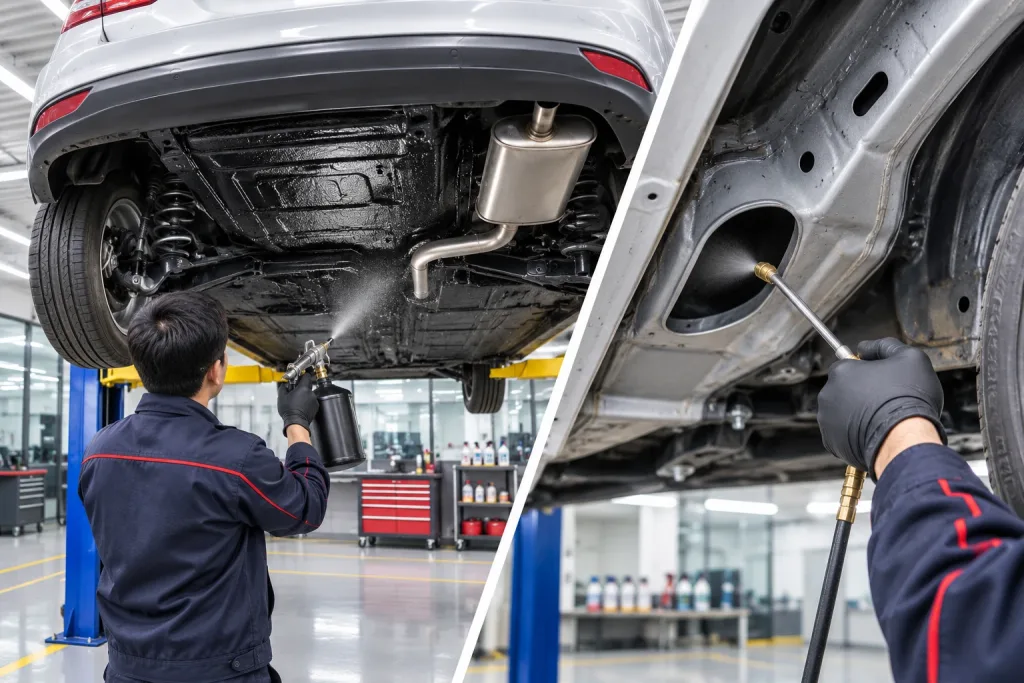
Ask three people what “undercoating” means and you may get three answers: a black spray under the car, a rust treatment, or a sound-deadening layer. All three are partly right. This guide explains what underbody coating actually is, what it does, what it does not do, and what separates a lasting application from one that peels off after a monsoon.
The short definition
Underbody coating is a protective material applied to the underside of a vehicle — the floor pan, chassis rails, sills, wheel arches, subframes and the seams between panels — to keep water, mud, grit and air away from the metal. Steel rusts when it has moisture and oxygen; the coating’s job is to put a barrier between the two and the metal, and to cushion the areas stones hit.
Depending on the product it may be a flexible rubberised film, a thick bitumen layer, a soft wax, a penetrating oil or a tough polyurethane. Those are quite different materials with different strengths — see how they compare — but the purpose is the same: slow corrosion on metal that is still sound.
Where it goes — and where it must not
A correct application covers the exposed metal of the floor pan, the chassis and subframe rails, the inner wheel arches, sill undersides, jacking points and the flanges and seams where water collects. Cavity waxes additionally go inside sills, rails and door bottoms through existing holes.
Just as important is what stays clear. Coating must never go on the exhaust and heat shields (it burns), brake discs, calipers and lines, ABS and oxygen sensors, drive shafts and CV boots, rubber bushings, steering joints or drain holes. A blocked drain traps water inside a sill and causes rust from the inside out — the exact problem you were trying to prevent. Careful masking is half the job.
What it protects against
- Moisture and standing water. In Lahore the monsoon leaves streets flooded for hours; water sits in seams and on flat floor sections long after the road dries.
- Mud and dust. Wet mud packed into seams and arch lips holds moisture against metal for days. Dust mixed with condensation does the same in slow motion.
- Stone chips. Gravel and debris thrown up by the tyres chip factory paint behind the wheels, exposing bare steel.
- Chemical attack. Road salt is not common in Lahore, but trips to northern areas in winter, industrial run-off and some cleaning chemicals do contribute.
What it does not do
Being clear about limits is the mark of an honest provider:
- It does not repair rust. Metal that is pitted, scaling or perforated needs treatment or welding first. Coating over active rust hides it and traps moisture.
- It is not permanent. Chips happen, films thin, waxes wash away. Annual checks and touch-ups are part of the deal.
- It does not change your warranty. Manufacturer warranty terms stay as written; most permit aftermarket protection applied correctly, but read the booklet.
- It is not sound-proofing or waterproofing. Thick coatings may dampen stone noise slightly; that is a side effect, not a promise.
- It is only as good as the preparation. The same product on clean, dry metal lasts years; on muddy, damp metal it fails in months.
Undercoating vs rustproofing vs rust treatment
People use these interchangeably. Roughly: undercoating is the sprayed film on exposed surfaces; rustproofing is the broader programme that may include cavity wax inside box sections; rust treatment is converting or removing existing corrosion before protection goes on. A thorough job may involve all three. Read the comparison →
What a good application looks like
- An inspection on the lift first. Nobody can quote or recommend honestly without seeing the underside.
- Thorough cleaning and drying. Degreased, mud removed, loose rust and failing old coating taken off, then dried properly.
- Rust treated, or repair recommended. Surface rust converted or primed per the datasheet; structural rust referred for welding.
- Masking of everything listed above.
- Even application at the specified thickness, worked into seams — not a single heavy coat.
- A lamp check, overspray cleaned, care notes and product information handed over.
This is exactly the sequence we follow — see the six steps.
Signs of a poor job
- Overspray on the exhaust, brake parts or paintwork.
- Coating sprayed over caked mud or obviously rusty, flaking metal.
- Drain holes sealed shut.
- Very thick, sagging coating in some places and bare metal behind brackets.
- No written note of the product used or its curing time.
A note on terminology you will hear in Pakistan
Locally the service is called “underbody coating”, “anti-rust coating”, “undercoat” or simply “coating”, and some workshops bundle it with wheel-arch liners or sound deadening. None of those names tells you what product is being used or how the surface will be prepared, so do not compare offers by name. Ask what material is sprayed, how thick, onto what preparation, and with what masked. A thick black layer sprayed in twenty minutes over a muddy underside and a prepared, masked, datasheet-thickness application are both called “coating” — and they are not the same service.
How long does it take and when can I drive?
A properly prepared job takes hours, not minutes, because washing, degreasing, rust treatment and especially drying cannot be rushed. After application the product has a touch-dry time and a longer full-cure time, both of which stretch in humid weather. Plan on leaving the car for the day and avoiding pressure washing or deep water until the stated cure time has passed. We give the exact figures for the product used on your car at hand-over.
Is it right for your car?
It is most worthwhile on a car driven daily through rain and standing water, parked outside, used on unpaved roads or kept for several years — and simplest on a new car with a clean underside. It is less compelling on a garaged car you will sell within a year. The honest way to decide is an inspection, where the recommendation can be “nothing needed yet”. Is undercoating worth it in Pakistan? →
Related: our undercoating service in Lahore · Can you undercoat over rust? · How long does it last?
Frequently asked questions
What is car underbody coating (undercoating)?
Underbody coating is a protective layer sprayed onto the cleaned, prepared underside of a car — the floor pan, chassis rails, sills, wheel arches and seams. Its job is to keep water, mud and road debris away from bare or thinly painted metal so corrosion starts later and spreads more slowly.
It is a preventive treatment. It does not repair rust that is already eating into the metal, and it only works as well as the cleaning and preparation underneath it.
Does undercoating stop rust completely?
No treatment makes a car rust-proof forever. A well-applied coating on clean metal greatly reduces the moisture and grit contact that drives corrosion, but stone chips, seam movement and neglected damage can still let rust start. That is why we recommend periodic underbody checks rather than a one-time “fit and forget” approach.
What is the difference between undercoating and rustproofing?
“Undercoating” usually means a sprayed protective film on the exposed underside. “Rustproofing” is a broader term that also covers cavity waxes injected inside box sections, doors and sills, and chemical rust converters on existing corrosion. The two can be combined; which you need depends on the car’s condition and how it is used. Read the full comparison.
Does undercoating reduce road noise?
Thicker rubberised coatings can slightly dampen the sound of stones and spray hitting the floor pan. It is a side benefit, not a guarantee, and it varies with the product, film thickness and the car. We do not sell undercoating as a sound-proofing solution.
Which parts should never be coated?
Exhaust pipes and heat shields (coating burns and smokes), brake discs, calipers and lines, ABS and oxygen sensors, drive shafts and CV boots, suspension joints and rubber bushings, drain holes and breather tubes, and any label or part the vehicle manufacturer says must stay uncoated. We mask these before spraying.
Ready to protect your car’s underside?
Book an underbody inspection. We look first, explain what we find, and only then quote — no pressure, no guesswork.