
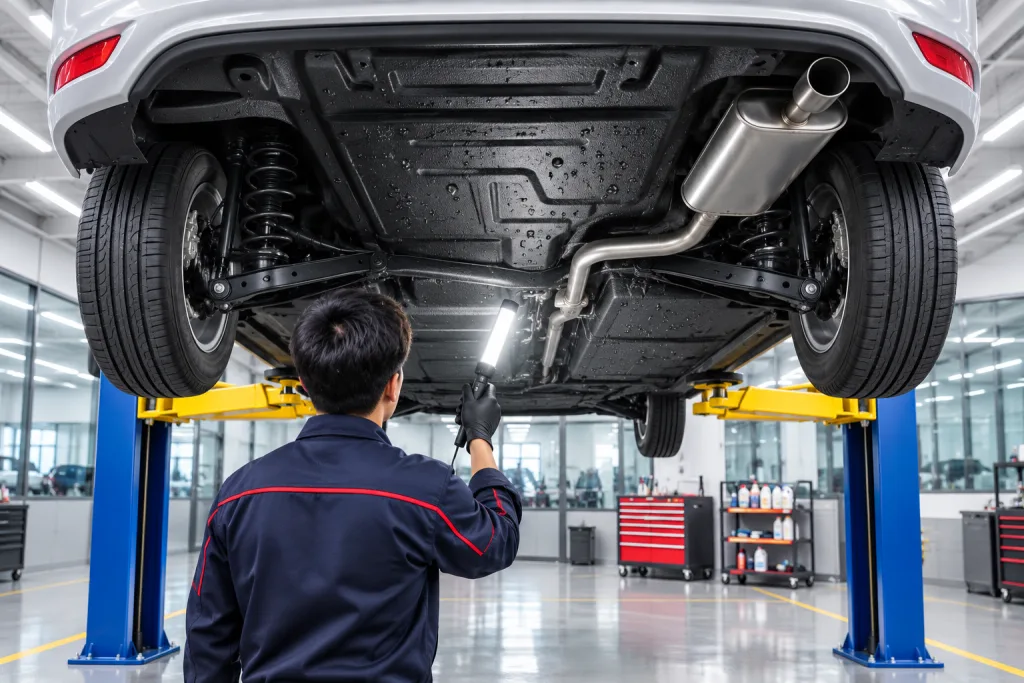
Most undercoating advice online is written for countries that salt their roads every winter. Pakistan is different: the threat is not salt but water, humidity, mud and time. That changes who benefits — and who does not. Here is a realistic assessment for Lahore and similar cities.
What Lahore does to the underside of a car
Monsoon flooding
From July to September many streets hold water for hours after heavy rain. Driving through it forces water into sills, seams and drain channels, soaks mud into every flange and leaves the floor pan wet long after the road dries. Repeated over several seasons, that is exactly the environment in which surface rust becomes scale.
Humidity
Summer humidity keeps metal from drying fully, especially inside enclosed box sections and under mud deposits. Rust does not need a flood — it needs moisture and time, and Lahore supplies both for months.
Dust and mud
Dry-season dust coats the underside; the first rain turns it into mud that packs into seams and arch lips and stays damp. Mud is a sponge held against steel.
Broken roads and speed bumps
Gravel, potholes and unmarked bumps chip paint behind the wheels and along the floor pan edges, exposing bare metal that the next shower then wets.
What Lahore mostly does not have
Road salt. That is the main driver of corrosion in Europe and North America, and it is largely absent here except on winter trips to northern areas. So the case for undercoating in Pakistan is about water, mud and longevity, not about salt — which also means the right product and approach can differ.
Who benefits most
- Daily drivers parked outdoors through monsoon seasons.
- Owners who keep cars for five years or more — corrosion is a slow process and protection is an investment in later years.
- Cars used on unpaved, muddy or flooded routes, including school runs through low-lying areas.
- New or near-new cars, where protection on clean metal is simplest and most effective. New car undercoating →
- 4x4s and SUVs used for northern trips, where gravel, river crossings and occasional winter salt add to the load.
- Used cars with light surface rust that is still treatable — acting now avoids a repair later. Rust and coating →
Who can reasonably skip it
- A garaged car, rarely driven in rain, on paved roads only.
- A car you plan to sell within a year or two with no existing underbody rust.
- A car whose underside already needs structural repair — spend the money on the repair first.
We say this at inspections and we would rather lose a job than sell one that is not needed.
Weighing it up
A fair summary of the case for and against, for a typical Lahore daily driver.
The case for
- Protects seams, rails and arches through monsoon seasons
- Keeps mud and standing water off bare and chipped metal
- Cheapest when done on clean metal before rust starts
- Documented protection helps when selling a well-kept car
- Annual checks catch other underbody issues early (leaks, loose shields)
The case against
- Costs money up front and needs occasional touch-ups
- Does nothing for rust that is already structural
- A poor job (no prep, over-thick, drains sealed) can do harm
- Low value for garaged, short-term or rarely-driven cars
- No guarantee of lifetime protection — anyone promising that is overselling
Common objections, answered honestly
“Modern cars don’t rust.” Modern cars rust much more slowly than cars of the 1990s thanks to galvanised panels and e-coat. They still rust at seams, welds, brackets and chips — the places factory protection is thinnest — and Pakistani monsoons give those places months of moisture every year. “Slower” is not “never”.
“The dealer said the car already has underseal.” It may well have PVC underseal on the main floor. Look at the edges, the brackets, the suspension mounts and behind the wheels — that is where protection usually stops and where rust usually starts. An inspection shows you exactly where the factory coverage ends on your car.
“I’ll just wash it underneath.” Rinsing mud off is genuinely useful and we recommend it. It does not protect bare chipped metal or seams that stay damp, and most owners never wash the underside at all.
“My uncle had it done and it peeled off.” Almost certainly a preparation failure — coating over damp or dirty metal — not evidence that undercoating does not work. It is evidence that who does it, and how, matters more than whether.
Cost versus value
We do not publish fixed prices because the job varies with vehicle size, condition and product — how pricing works. The fair comparison is not “coating versus nothing” but “coating now versus rust treatment, welding and resale penalty later”. For a car kept through several monsoons, that comparison usually favours protection applied early. For a car sold next year, it usually does not.
The honest way to decide
Have the underside inspected. It costs you an hour, you see the actual condition with your own eyes, and the recommendation can be “nothing needed yet, check again after the monsoon”. That is a better basis for a decision than any article, including this one. What the inspection covers →
Related: our undercoating service in Lahore · What is undercoating? · How long does it last?
Common questions
Is undercoating worth it in Pakistan?
For many owners, yes — especially if the car is driven through monsoon waterlogging, parked outdoors, used on muddy or unpaved roads, or kept for several years. Lahore’s humid summers and standing water in the rainy season give rust the two things it needs: moisture and time.
It is less compelling for a car that is garaged, rarely driven in rain and sold within a year or two. We are honest about this during the inspection.
I plan to sell the car in a year — is it still worth it?
Probably not purely for protection, unless the underside already shows early rust that a buyer would notice. A clean, documented underbody can help at resale, but we would rather tell you to wait than sell a service you do not need.
Does a small hatchback like an Alto really need it?
Small cars have less underside, but it sits closer to the road spray and often has thinner factory protection. If the car is parked outside, used daily in rain and meant to be kept for years, protection is just as relevant — and usually quicker to apply.
Is undercoating different for SUVs and 4x4s?
The principles are the same but the area is larger, there is more exposed chassis, and these vehicles are more likely to see mud, river crossings and northern-area trips. Ladder-frame vehicles have long box sections where cavity protection matters, and more heat shields and sensors to mask.
How much does undercoating cost?
Fixed package prices for the Toyota models we coat most often are listed on our prices page — that page is the single source of current prices, so we do not repeat figures here. For other vehicles the price depends on size, how much cleaning and rust treatment the underside needs and the product chosen, so we quote after an underbody inspection rather than guessing from a phone call. Every quote is written and itemised.
Ready to protect your car’s underside?
Book an underbody inspection. We look first, explain what we find, and only then quote — no pressure, no guesswork.