
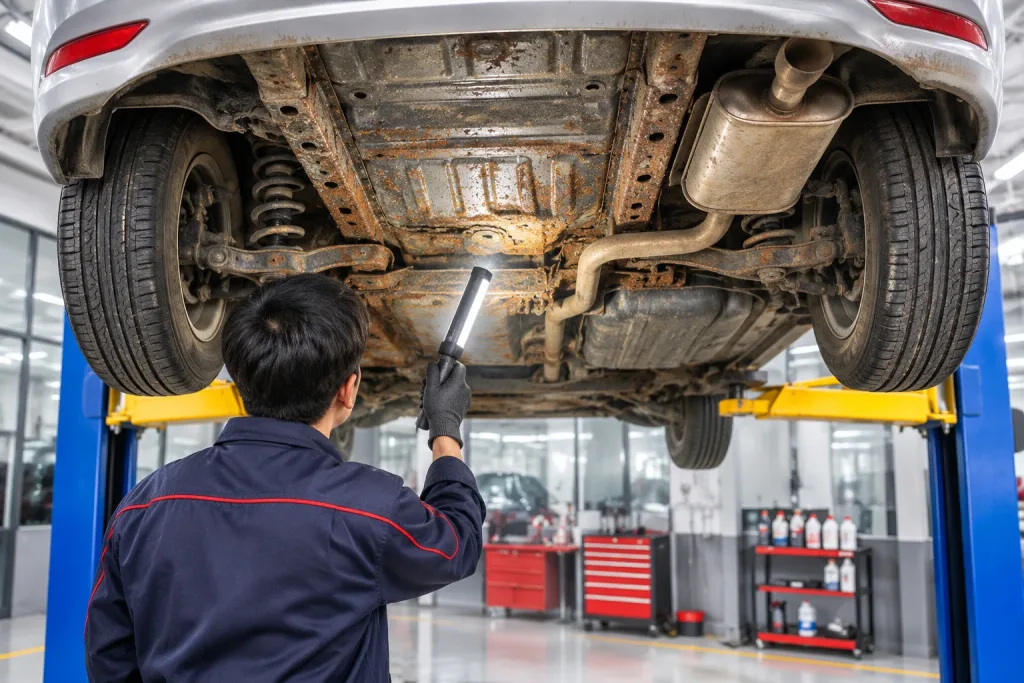
You have just taken delivery of a new car and someone — the dealer, a friend, a forum — says “get it undercoated before the rains”. Is that good advice or an upsell? Usually a bit of both. Here is how to decide calmly.
What factory protection actually covers
Modern cars leave the factory with electro-deposited primer (“e-coat”) over the whole body shell, seam sealer on many joints and, on some models, PVC-based underbody protection on the floor pan and arches. This is good — far better than cars of thirty years ago. But coverage is not uniform: spot-welded flanges, bracket edges, cut edges of panels, bolt heads, suspension components and areas masked during factory painting often have thin or no protection. Which areas, and how much, varies by manufacturer, model and even production plant. The only way to know is to look at your car on a lift.
Why a new car is the ideal time
- Clean, sound metal. Coating bonds best to a surface with no rust, no caked mud and no failing old layer. Preparation is quick and the result lasts.
- Before the first monsoon. The first rainy season is when water first sits in seams and drains. Protection applied before that starts the clock from zero.
- Before chips accumulate. Behind the wheels, factory paint is chipped to bare steel within months on gravel-strewn roads. A chip-resistant film there pays for itself.
Read the warranty booklet first
This matters, and we will not guess it for you. Most manufacturers’ corrosion warranties stay valid when aftermarket protection is applied correctly, but booklets commonly exclude damage caused by blocked drain holes, coated components, or substances that attack rubber and sealants. Some specify that protection must not cover certain labels or sensors. Bring the booklet to the inspection; we work within its terms and will decline to coat anything it excludes. If a dealer tells you aftermarket undercoating voids the whole warranty, ask them to show you the clause.
What a proper new-car job includes
- Lift inspection, confirming the underside is clean and checking factory coverage gaps — we show you where they are.
- Washing and thorough drying even though the car is new (transport dust, PDI residue, first rain).
- Masking of exhaust, brakes, sensors, drive shafts, bushings, drain holes and manufacturer-specified exclusions.
- Application of a compatible coating at the specified thickness to exposed floor, rails, arches and seams.
- Optionally, cavity wax in sills and rails if the model is known for inner-sill corrosion or you plan to keep the car long-term.
- Lamp check, overspray cleaned, hand-over notes with curing times and product information.
Dealer-fitted protection packages
Many dealerships offer undercoating at delivery as part of an accessories package. It can be perfectly good, and it can be a quick spray by a third party in the delivery bay. Ask the same questions you would ask anyone: which product, what preparation, what is masked, what documentation do I receive, and what are the written terms? If the answers are vague, you are entitled to decline the package and have the work done elsewhere — your warranty does not depend on where the protection was applied, only on it being applied correctly.
Timing within the first year
The ideal moment is after the first few hundred kilometres — once the car has been driven enough to shed assembly-line dust and any transport wax, but before the first monsoon season and before stone chips have exposed bare steel behind the wheels. If you have missed that window, the next best time is now: the underside is still far closer to “new” than it will ever be again, and preparation is quick.
When it is not worth it
Honestly: if the car lives in a garage, is rarely driven in rain, never sees unpaved roads and will be sold within a couple of years, the money may be better spent elsewhere. We tell owners this at inspections. Lahore driving, however, usually means standing water, mud and outdoor parking at some point in the car’s life.
Common mistakes with new cars
- Spraying thick bitumen over factory PVC without checking compatibility or adhesion.
- Sealing drain holes “for extra protection” — this causes rust rather than preventing it.
- Coating sensors and brake parts because “it was faster”.
- Choosing a provider on price alone and getting a single thin coat with no masking.
Aftercare on a coated new car
Respect the curing time before washing or heavy water exposure, rinse the underside after muddy drives, and book an annual underbody check to touch up chips while they are small. How long does undercoating last? →
Related: our undercoating service · materials and compatibility · Is it worth it in Pakistan?
New-car questions
Should I undercoat a brand-new car?
A new car is the easiest to protect because the underside is clean and rust-free, so the coating bonds to sound metal. Factory protection varies by model and often leaves seams, spot welds, brackets and wheel-arch edges with thin coverage. Check your vehicle’s warranty booklet first — most manufacturers allow aftermarket underbody protection as long as it does not block drain holes, cover sensors or touch components they exclude. Bring the booklet to the inspection and we will go through it with you.
Is undercoating safe for my car’s parts and warranty?
Applied correctly — on clean metal, away from exhaust, brakes, sensors, moving parts and drain holes — underbody coating does not harm the car. Problems come from careless application. For warranty, read your manufacturer’s booklet: most permit protective coatings but exclude damage caused by blocked drains or coated components. We work within those limits.
When can I drive the car after undercoating?
Every product has its own touch-dry and full-cure times, and both depend on temperature and humidity — Lahore’s humid monsoon days slow drying noticeably. We follow the manufacturer’s datasheet and tell you the specific waiting time for the product used on your car, and we recommend avoiding heavy water contact until it has fully cured.
How long does underbody coating last?
There is no honest single number. Lifespan depends on the product type, film thickness, how well the metal was prepared, how the car is driven (gravel, floods, speed bumps) and whether chips are touched up. Flexible rubberised and polyurethane coatings generally outlast thin bitumen or oil treatments, but every product’s datasheet gives its own expectations. We recommend an underbody check at least once a year. Read more.
New car? Start with a look at the underside
Book an inspection before the first monsoon. We will show you where factory protection stops and let you decide.