
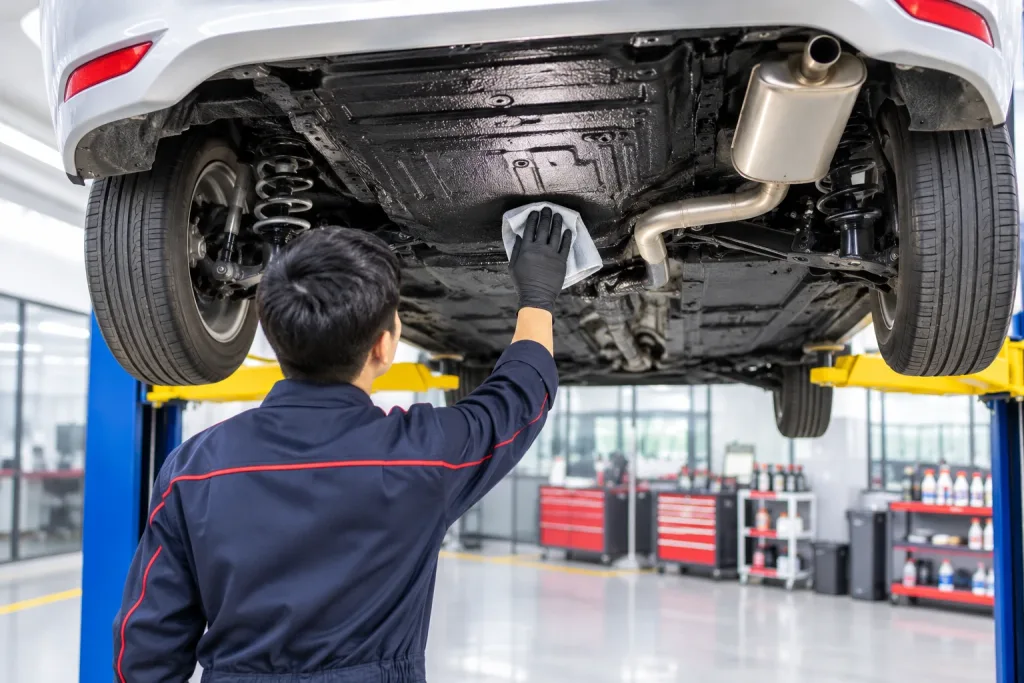
“Do you do undercoating or rustproofing?” is one of the most common questions we hear — and the honest answer is that the words overlap. This guide untangles four terms that get mixed up: underbody coating, rustproofing, cavity wax and rust treatment, so you can ask for the right thing.
The four terms, defined
Underbody coating (undercoating)
A protective film sprayed onto the exposed underside: floor pan, chassis rails, sills, arches, subframes and seams. It shields metal from water, mud, grit and chips. Materials range from rubberised films to bitumen, polyurethane and waxes. What is undercoating? →
Rustproofing
The umbrella term for a programme that protects a car against corrosion. It usually includes underbody coating and treatment of enclosed cavities — the hidden inside surfaces of sills, chassis box sections, door bottoms and pillars — where rust often starts unseen. Some people use “rustproofing” to mean only the cavity part; always ask what is included.
Cavity wax (cavity protection)
A thin, creeping wax injected through existing holes into enclosed sections. It spreads by capillary action, displaces moisture and stays soft so it self-heals around small chips. It does not form a durable exterior film and needs periodic top-ups.
Rust treatment
Dealing with corrosion that already exists: mechanical removal of scale, chemical rust converters that stabilise light surface oxide, priming — and, where metal is thin or holed, cutting out and welding. Treatment comes before any protection. How we assess and treat rust →
Side by side
| Measure | Where | Protects against | Durability | Typical use |
|---|---|---|---|---|
| Underbody coating | Exposed underside | Water, mud, chips on outer surfaces | Years if prepared well; chips need touch-up | Most cars, especially before first monsoon |
| Cavity wax | Inside sills, rails, doors | Condensation and trapped water inside box sections | Needs periodic top-up | Older cars; cars with blocked or poor drains; long-term keepers |
| Rust converter / primer | On existing surface rust | Stabilises light oxide before coating | Depends on topcoat | Used cars with surface rust |
| Welding / repair | Perforated or thin metal | Restores structure | Permanent if then protected | Structural corrosion — before any coating |
A complete “rustproofing” job may use all four. Ask any provider to list which they are quoting.
Why the distinction matters
Rust rarely starts on the big flat areas you can see. It starts inside sills where drains are blocked, in seam flanges, behind brackets and at spot welds. A beautiful exterior undercoat on a car whose sills are rusting from the inside gives false reassurance. Equally, cavity wax alone does nothing for the exposed floor pan being sand-blasted by road grit. Matching the measure to the problem is the whole skill.
Which does your car need?
- New or near-new car, kept for years, driven in rain: underbody coating of exposed areas is the main benefit; cavity wax is a sensible addition on models known for sill corrosion.
- Used car with light surface rust: rust treatment first, then coating; cavity wax if drains were blocked or sills show early rust.
- Used car with flaking or holed metal: repair first. No coating or wax should be sold until that is done.
- Car used off-road or on gravel regularly: a chip-resistant film coating (rubberised or polyurethane) matters most; cavities on ladder-frame 4x4s benefit from wax.
Only an inspection can tell which applies — what the inspection covers.
Compatibility between measures
Order and chemistry matter. Converter must fully react before primer or coating goes over it. Oil-type cavity treatments that seep onto exterior surfaces can stop film coatings from bonding. Old flaking undercoat must be removed before anything new. We check these against the product datasheets rather than assuming.
Three typical cars, three different answers
A two-year-old sedan, parked outside, driven daily. The exposed underside is still clean; the sills have never seen mud inside. The sensible programme is a film coating of floor, rails and arches now, cavity wax if the owner plans to keep the car for many years, and an annual check. No rust treatment needed.
A nine-year-old hatchback with orange staining from the sill drains. The staining says water has been sitting inside the sills. The right order is: clear the drains, inspect inside the sills with a borescope or through access holes, treat surface rust on exposed areas, inject cavity wax, then coat the exterior. Skipping the cavity step here would be coating the outside of a problem.
A 4x4 used for northern trips with flaking rust on the chassis rails. Flaking means scale. All loose material must come off and the remaining steel probed. If it is sound, treat and coat with an abrasion-resistant film and wax the frame cavities; if it is thin, the rail needs a fabricator before anyone sprays anything. This is the case where “rustproofing” sold as a quick spray does the most harm.
Terminology when getting quotes
To compare offers fairly, ask three questions: Which exposed areas will be coated and with what product? Will cavities be treated, and how? What happens to existing rust? If the answers are vague, the quote is too. How we quote →
Related: our undercoating service · materials and safety
Questions on this topic
What is the difference between undercoating and rustproofing?
“Undercoating” usually means a sprayed protective film on the exposed underside. “Rustproofing” is a broader term that also covers cavity waxes injected inside box sections, doors and sills, and chemical rust converters on existing corrosion. The two can be combined; which you need depends on the car’s condition and how it is used. Read the full comparison.
What is cavity wax and do I need it as well?
Cavity wax is a thin, creeping protective wax injected into enclosed box sections — sills, chassis rails, door bottoms — where sprayed underbody coating cannot reach. Rust often starts inside these hidden sections. Whether you need it depends on the car’s age, drain condition and what the inspection shows; it is a separate step from the exposed-underside coating.
What types of underbody coating are there?
The main families are rubberised (flexible, chip-resistant film), bitumen/asphalt-based (thick, economical, less flexible), wax-based (self-healing, often used in cavities), oil-based (penetrating, needs re-application) and polyurethane/hybrid coatings (tough, more expensive). Each has trade-offs in durability, flexibility, drying time and how easy later inspection is. We explain which product we propose for your car and why, and you can see its datasheet.
Can new coating go over an old underbody coating?
Only if the old layer is sound, clean and compatible with the new product. Flaking or lifting old coating must be removed first, otherwise the new layer fails with it. Mixing incompatible chemistries (for example some oils under rubberised products) can stop the new coating from bonding — we check compatibility against the datasheet.
Ready to protect your car’s underside?
Book an underbody inspection. We look first, explain what we find, and only then quote — no pressure, no guesswork.