
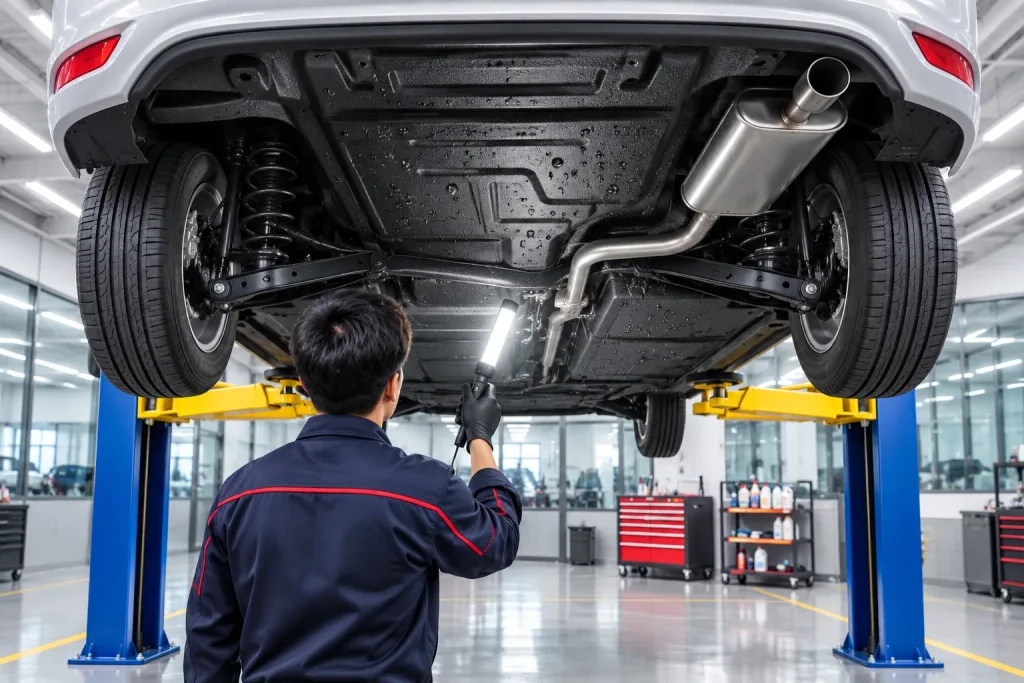
Anyone who gives you a single number — “five years”, “lifetime” — without asking about your car, the product and how you drive is guessing or selling. The lifespan of underbody coating is a range, and you control several of the factors that decide where in that range your car lands.
Why there is no single answer
Two identical cars coated on the same day with the same product can end up very differently: one garaged and driven on tarmac, the other parked outside and taken through flooded streets and gravel every week. Add in different products (a soft wax versus a polyurethane film), different film thicknesses and different levels of preparation, and “how long does it last” has to become “what decides how long it lasts”.
The six factors that decide lifespan
1. Preparation
The biggest factor by far. Coating on clean, dry, rust-free or properly treated metal bonds to the steel. Coating on mud, oil film or damp metal bonds to the dirt and lifts — often within one rainy season. Why cleaning and drying take so long →
2. Product type
Flexible rubberised and polyurethane films resist chips and stay bonded through body flex. Bitumen layers are economical but crack as they age. Waxes self-heal but wash off and need top-ups. Oils need frequent re-application. Each product’s datasheet gives its own expectations; we do not quote a universal figure. Compare types →
3. Film thickness
Too thin protects little; too thick sags, cracks and skins over before solvents escape. The manufacturer’s specified thickness, reached in the right number of passes, is the target.
4. Driving conditions
Gravel and broken roads chip any coating. Deep water lifts edges. Speed bumps taken fast grind the floor pan. Lahore’s monsoon is the main stress; northern-area trips add gravel and, in winter, occasional salt.
5. Maintenance
Rinsing mud off after wet drives, keeping drain holes clear and touching up chips before rust forms underneath can double the useful life of the same coating.
6. Mechanical work
Suspension, exhaust and gearbox jobs disturb coating. A quick touch-up after such work prevents a bare patch from becoming a rust patch.
Typical failure modes and what to do
| Symptom | Likely cause | Response |
|---|---|---|
| Edges lifting after first monsoon | Applied over damp or dirty metal | Strip loose areas, re-prepare, re-coat |
| Cracks in a thick dark layer | Aged bitumen or over-thick application | Check for water ingress behind cracks; remove and re-coat affected areas |
| Bare metal chips behind wheels | Normal stone impact | Clean and touch up at annual check |
| Wax gone from sill undersides | Pressure washing | Re-apply wax; use gentler washing |
| Coating peeling in sheets with rust beneath | Sprayed over active rust | Full removal, rust treatment or repair, then re-coat |
Realistic expectations by how the car is used
Without quoting a number that would be wrong for your car, here is how the factors stack up in practice. A garaged car driven mostly on tarmac, coated on clean metal with a quality film, will usually go many years needing nothing more than occasional touch-ups behind the wheels. A daily driver parked outside through Lahore monsoons, rinsed occasionally and checked annually, will need touch-ups more often but the film itself stays sound. A car driven weekly on gravel or through flooded streets, never rinsed and never checked, will show chips and lifting edges within a couple of seasons regardless of the product — and the coating is not what failed; the maintenance did.
Waxes and oils live on a different clock entirely. They are designed to be topped up, often every season or year, and judging them by film-coating standards misses the point. The question for them is not “how long until it fails” but “how often does it need refreshing” — and the datasheet answers that.
Re-application: when, not every X years
Re-apply when inspection shows thinning, chipping, cracking or lifting — not on a fixed calendar. For most film coatings on a well-prepared car, that means spot touch-ups at annual checks for years before a wider re-coat is needed. Waxes and oils are different: they need planned top-ups as part of their design.
How to make it last
- Insist on inspection, cleaning, drying and rust treatment before coating — or go elsewhere.
- Respect the product’s curing time before washing or heavy water exposure.
- Rinse the underside after muddy or flooded drives; keep drains clear.
- Book an annual underbody check; touch up chips early. Book a check →
- After mechanical work underneath, have disturbed areas touched up.
What about warranties?
A written warranty with clear conditions is worth something; a verbal “lifetime” promise is not. Ask what is covered, what is excluded and what inspection schedule is required. Our aftercare guidance and any written warranty terms are confirmed at booking and given at hand-over — see the FAQs for how we approach warranty questions.
Related: our undercoating service · What is undercoating? · Can you coat over rust?
Due for a check?
An annual underbody look catches chips while a touch-up is enough. Book a slot and we will confirm it with you.