
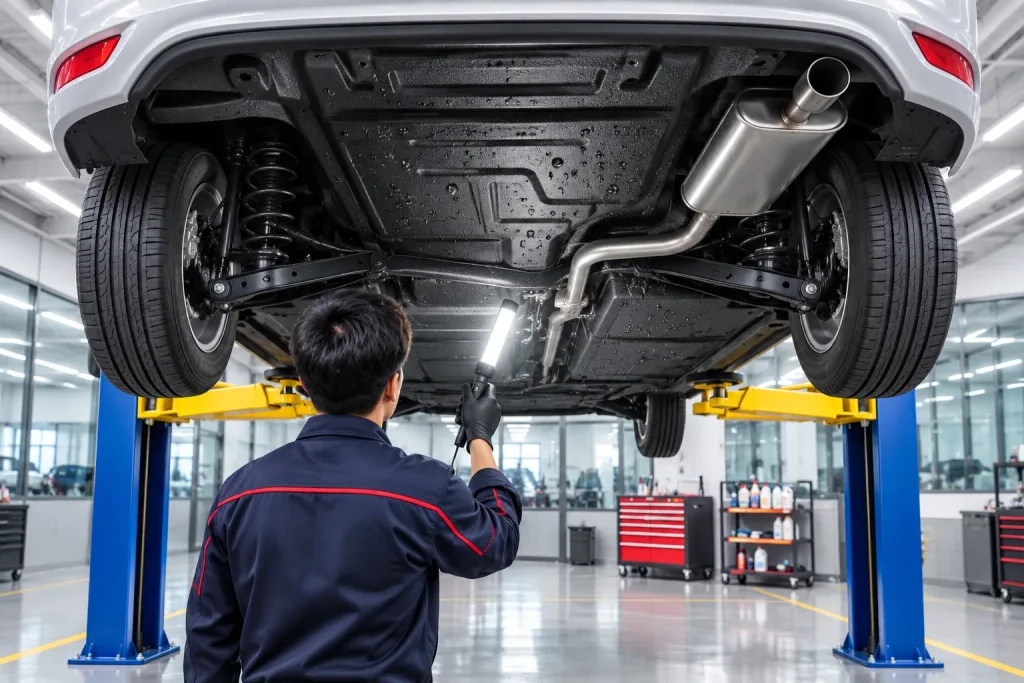
The short answer: you can coat over treated surface rust, you should never coat over loose, scaling or perforated rust, and the difference is something you can only judge with the car on a lift. The long answer explains why the wrong choice does real damage.
Why sealing rust in makes it worse
Rust is iron oxide, and it keeps forming as long as the steel has moisture and oxygen. A thick coating sprayed over active rust does three bad things: it bonds to the loose oxide instead of the metal, so it lifts; it traps whatever moisture was in the porous rust against the steel; and it hides the problem, so the owner finds out only when a probe goes through the metal. The term for this in the trade is “painting over the problem”, and it is the main reason cheap undercoating jobs end up costing more than doing it right.
Three kinds of rust, three answers
Surface rust → treat, then coat
A light orange film on bare or chipped metal, with the steel underneath still full thickness. This is normal on any used car — around brackets, suspension mounts, rail edges and chips behind the wheels. The right process: clean and degrease, remove the loose oxide mechanically, apply a rust converter or primer as its datasheet directs (reaction time, drying, conditions), then coat. Done properly, this is a durable result.
Scale and flaking → remove, probe, then decide
Layered rust that comes off in flakes, typically around sill bottoms, jacking points, seams and arch lips. Here the metal has lost thickness. All loose material must come off, and what remains must be probed. If the remaining steel is solid, treatment and coating can proceed. If it is thin or soft, treatment alone is a cosmetic fix on a structural problem.
Perforation and structural corrosion → repair first
Holes, soft spots or corroded seams in load-bearing areas: chassis rails, suspension mounting points, floor pan edges, seatbelt anchorages. This is a body-shop job — cut out, weld in new metal, then protect. No honest provider will coat it, and you should walk away from one who offers to.
Quick reference
| What you see | Metal condition | Correct action |
|---|---|---|
| Orange film, metal firm when probed | Full thickness | Clean, convert/prime per datasheet, coat |
| Flakes come off, pitting underneath | Reduced thickness | Remove all loose material, probe; coat only if solid |
| Holes, soft areas, bubbling seams | Structurally compromised | Weld/repair first, then protect |
| Old undercoat lifting with rust beneath | Unknown until exposed | Strip old coating, assess, then decide |
What rust converters can and cannot do
Rust converters chemically change light surface oxide into a stable compound that can be primed and coated. They are useful — and widely misused. They do not work through scale, they need a clean surface and the specified reaction and drying time, and the topcoat must be compatible. Applying a converter and then spraying a thick coating ten minutes later wastes both products. We follow the datasheet of the specific converter used, and we will show it to you.
Old coating with rust underneath
A common scenario on used cars: a previous undercoat, now cracked or lifting, with rust visible at the edges. The old layer has to come off — at least everywhere it is loose — before anyone can see what is underneath. Sometimes that reveals sound metal; sometimes it reveals why the old coating was applied. Either way, spraying a new layer over a failing one just adds a second layer that will fail.
Why we insist on the inspection
None of the judgements above can be made over the phone or from a photo of a wheel arch. Rust that looks dramatic can be surface-only; rust that looks minor can hide a thin sill. On the lift we probe, photograph and categorise area by area, then recommend — including “repair first” when that is the truth. What the inspection covers →
Questions to ask any provider about rust
- Will you show me the rusted areas on the lift or in photos before quoting?
- How do you remove loose rust — mechanically, chemically, or not at all?
- Which converter or primer do you use, and what reaction and drying time does its datasheet require?
- What will you do if you find metal that is too thin to coat?
- Will the treated areas be photographed before the coating goes over them?
A provider who answers these clearly is treating rust; one who waves them away is painting over it.
After treatment: what to watch
Treated and coated areas should look uniform and stay firmly bonded. If, months later, the coating over a treated spot lifts, blisters or shows orange staining at its edges, the rust underneath was not fully arrested — either the oxide was not removed to sound metal or the converter did not react properly. That is exactly why we photograph the prepared metal before coating and recommend an annual check: a small failure caught early is a touch-up, not a repeat of the whole job.
Buying a used car?
An underbody inspection before purchase tells you more than paint and mileage. Surface rust is normal and treatable; hidden scale in the sills or a welded chassis rail changes the price or the decision. We are happy to inspect a car you are considering.
Related: our undercoating service · What is undercoating? · How long does it last?
Questions about rust
Can a used car with some rust be undercoated?
Often yes, but only after an honest inspection. Light surface rust can be cleaned, treated and primed before coating. Flaking, scaling or perforated metal cannot simply be sealed over — coating would trap moisture and hide the problem. In those cases we point out what needs welding or replacement first.
Does undercoating stop rust completely?
No treatment makes a car rust-proof forever. A well-applied coating on clean metal greatly reduces the moisture and grit contact that drives corrosion, but stone chips, seam movement and neglected damage can still let rust start. That is why we recommend periodic underbody checks rather than a one-time “fit and forget” approach.
Can new coating go over an old underbody coating?
Only if the old layer is sound, clean and compatible with the new product. Flaking or lifting old coating must be removed first, otherwise the new layer fails with it. Mixing incompatible chemistries (for example some oils under rubberised products) can stop the new coating from bonding — we check compatibility against the datasheet.
What happens during the underbody inspection?
The car is lifted and we check the chassis rails, floor pan, sills, wheel arches, subframes, suspension mounts and seams for rust, damage, leaks, loose heat shields and previous repairs. You get a clear explanation of what we found, what we recommend (including “nothing needed yet” when that is the honest answer) and a written quote. More about inspections.
Not sure how bad the rust is?
Book an inspection. You will see the photos and hear the honest category for each area — treat, remove, or repair first.