
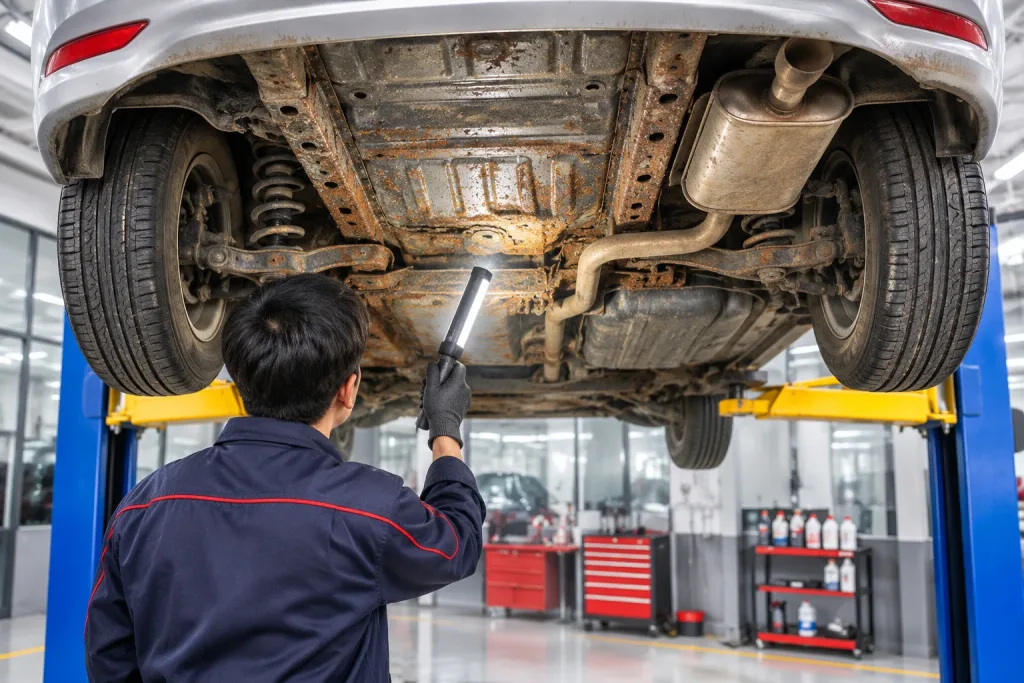
Walk into five workshops and you may be offered five different “undercoatings” — a sticky black bitumen, a rubbery grey film, a clear wax, a thin oil or a two-part polyurethane. They are not interchangeable. This guide explains each family in plain terms so the conversation at the inspection makes sense.
Rubberised coatings
Films containing synthetic rubber, solvent- or water-based. Cured, they stay flexible, bridge seams and absorb stone impacts. They are the most common choice for exposed floor pans and arches on passenger cars. Strengths: chip resistance, flexibility, reasonable cost. Weaknesses: must be applied at the right thickness in multiple passes; over-thick coats sag; they need clean, dry metal to bond.
Bitumen (asphalt) based coatings
Thick, dark, economical and good at damping noise. The trade-off is flexibility: bitumen hardens with age and heat cycles, cracks, and cracks let water behind the film where it cannot dry. Suitable on sound metal with regular inspection; a poor choice over any rust or on a car driven hard on rough roads.
Wax-based coatings and cavity waxes
Soft protective waxes that stay pliable and self-heal around small chips. Thin cavity waxes are injected into sills, chassis rails and door bottoms and creep along seams by capillary action — the only practical protection for enclosed sections. Weaknesses: they wash off under pressure cleaning and need periodic top-ups; on exposed surfaces they attract dust.
Oil-based (penetrating) treatments
Thin oils that displace moisture and reach tight seams. They are quick to apply and inexpensive but form no durable film, drip in heat, pick up dust and need re-application. They can also prevent later film coatings from bonding, which matters if you change approach later.
Polyurethane and hybrid coatings
Tough, abrasion-resistant one- or two-part films, often used on commercial and off-road vehicles. Highest durability, highest price, and the most demanding application: precise surface preparation, mixing ratios and pot life. Excellent where budget allows and the car sees gravel regularly.
At a glance
| Type | Flexibility | Chip resistance | Cavities | Upkeep | Best for |
|---|---|---|---|---|---|
| Rubberised | High | High | ✕ No | Touch-ups | Most passenger cars |
| Bitumen | Low–medium | Medium | ✕ No | Inspect for cracks | Budget, sound metal |
| Wax | Self-healing | Low | ✓ Yes | Periodic top-up | Enclosed sections, older cars |
| Oil-based | Fluid | Low | ✓ Yes | Frequent | Quick seasonal treatment |
| Polyurethane | Medium–high | Very high | ✕ No | Long intervals | Off-road, heavy use |
Combining types
A thorough job often pairs a film coating on exposed surfaces with cavity wax inside box sections. What should not be combined without checking is an oil or wax under a film coating on the same surface — compatibility is checked against datasheets, never assumed. Compatibility and safety →
How to choose
- Start with the car’s condition — found at the inspection, not guessed.
- Consider use: daily tarmac, monsoon flooding, gravel, northern trips.
- Decide how much upkeep you will realistically do.
- Ask for the datasheet of whatever is proposed and read the application conditions and curing times.
Related: our undercoating service · Undercoating vs rustproofing · How long does it last?
Related questions
What types of underbody coating are there?
The main families are rubberised (flexible, chip-resistant film), bitumen/asphalt-based (thick, economical, less flexible), wax-based (self-healing, often used in cavities), oil-based (penetrating, needs re-application) and polyurethane/hybrid coatings (tough, more expensive). Each has trade-offs in durability, flexibility, drying time and how easy later inspection is. We explain which product we propose for your car and why, and you can see its datasheet.
Which product or brand do you use?
The product depends on your car’s condition and your budget, and we only use materials for which we can show you the manufacturer’s technical datasheet. Ask during the inspection — we will tell you exactly what is proposed, its intended use, and its drying and re-inspection guidance.
What is cavity wax and do I need it as well?
Cavity wax is a thin, creeping protective wax injected into enclosed box sections — sills, chassis rails, door bottoms — where sprayed underbody coating cannot reach. Rust often starts inside these hidden sections. Whether you need it depends on the car’s age, drain condition and what the inspection shows; it is a separate step from the exposed-underside coating.
Ready to protect your car’s underside?
Book an underbody inspection. We look first, explain what we find, and only then quote — no pressure, no guesswork.