
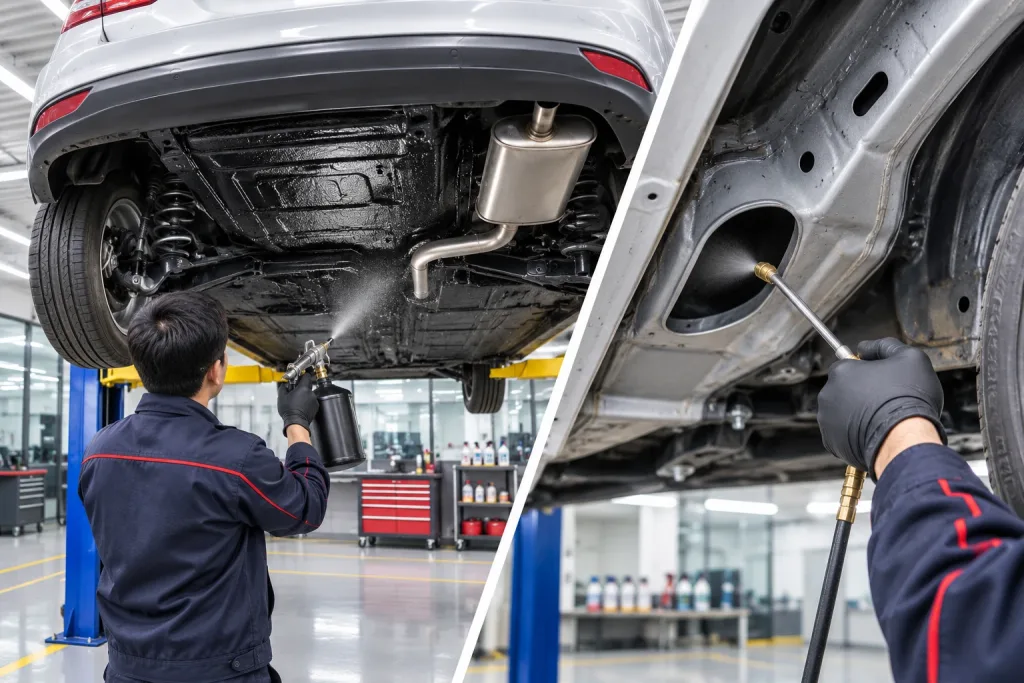
A company that sells undercoating writing about its disadvantages may seem odd. We think it is the only honest way to earn a booking. Most disadvantages are really the consequences of poor application, but some are inherent, and for some owners the right answer is “don’t”.
Disadvantages of poor application
Rust hidden under the coating
Coating sprayed over active rust bonds to the oxide, lifts, and hides the corrosion until it is far worse. This is the single biggest risk and the reason inspection and treatment come first. Why sealing rust in makes it worse →
Trapped moisture
Coating applied to damp metal or into wet seams seals water against the steel. In Lahore’s humidity, drying takes real time; rushing it guarantees early failure.
Blocked drain holes
Sills, doors and rails have drains for a reason. A provider who sprays them shut “for extra protection” causes rust from the inside — the opposite of the intention.
Damage to components
Overspray on the exhaust smokes and smells for weeks and can be a fire risk; coating on brake parts affects braking; coated sensors fail; solvents attack rubber bushings and CV boots. All avoidable with masking. What must never be coated →
Over-thick application
“More is better” thinking produces sagging, cracking layers that skin over before the solvent escapes, then split and let water behind the film.
Inherent disadvantages
- Cost. A proper job takes hours of preparation. Cheap jobs skip exactly those hours.
- Maintenance. Chips need touch-ups; waxes need top-ups; an annual check is sensible. It is not fit-and-forget.
- Harder visual inspection of the metal. A coated surface hides the steel underneath. That is why we photograph the bare, prepared underside before coating and recommend keeping the record.
- Curing downtime. The car should not be washed or driven through deep water until the product has cured.
- Weight and odour. Negligible weight on a car; solvent odour for a few days with some products.
- Removal is laborious if a future repair requires bare metal.
When to skip it
- The car is garaged, rarely driven in rain and used on paved roads only.
- You will sell within a year or two and the underside is still clean.
- The underside has structural rust — spend on repair first.
- You cannot find a provider who will inspect first, mask properly and show you the product datasheet. A bad job is worse than none.
How we reduce the risks
Inspection on the lift, categorised rust assessment, thorough cleaning and drying, systematic masking, application at datasheet thickness and a lamp check before hand-over. It is slower and costs more than a quick spray, and that is the point. The six steps →
Related: our undercoating service · Is it worth it in Pakistan?
Related questions
Which parts should never be coated?
Exhaust pipes and heat shields (coating burns and smokes), brake discs, calipers and lines, ABS and oxygen sensors, drive shafts and CV boots, suspension joints and rubber bushings, drain holes and breather tubes, and any label or part the vehicle manufacturer says must stay uncoated. We mask these before spraying.
Can new coating go over an old underbody coating?
Only if the old layer is sound, clean and compatible with the new product. Flaking or lifting old coating must be removed first, otherwise the new layer fails with it. Mixing incompatible chemistries (for example some oils under rubberised products) can stop the new coating from bonding — we check compatibility against the datasheet.
I plan to sell the car in a year — is it still worth it?
Probably not purely for protection, unless the underside already shows early rust that a buyer would notice. A clean, documented underbody can help at resale, but we would rather tell you to wait than sell a service you do not need.
Ready to protect your car’s underside?
Book an underbody inspection. We look first, explain what we find, and only then quote — no pressure, no guesswork.