
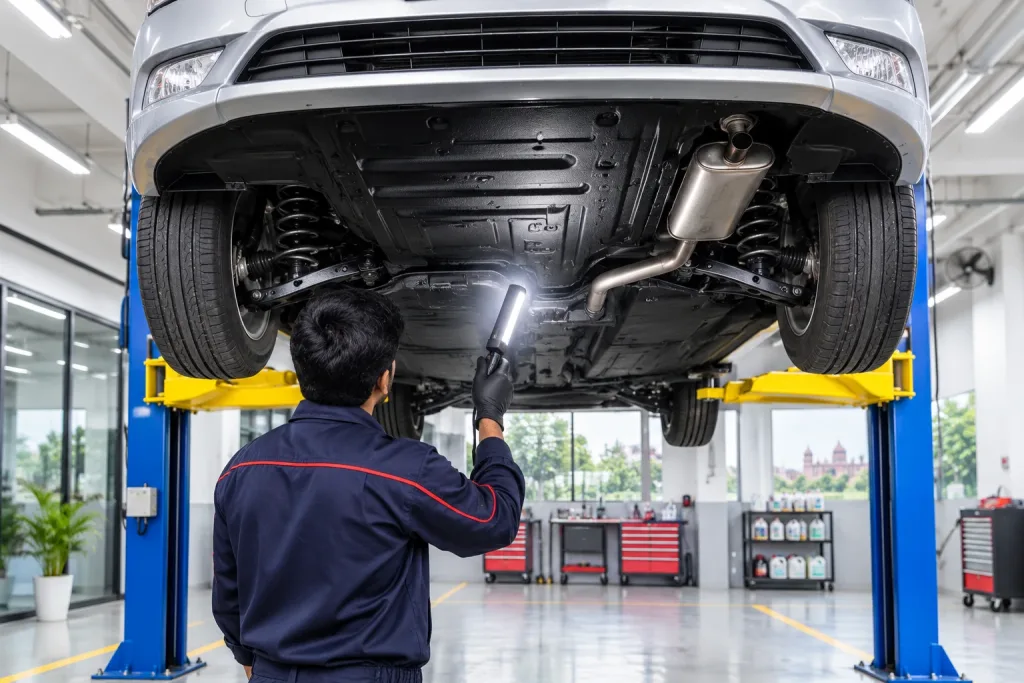
“When can I drive it?” is the most practical question after undercoating, and the honest answer has two parts: when it is touch-dry and when it is fully cured. They can be hours apart — or days — depending on the product and the weather.
Touch-dry vs fully cured
Touch-dry means the surface no longer transfers to a finger. The film underneath is still releasing solvent or water and has not reached its final hardness or adhesion. Fully cured means the coating has reached the properties the manufacturer specifies: flexibility, adhesion, water and chip resistance. Driving gently after touch-dry is often acceptable; pressure washing, deep water and gravel should wait for full cure.
What changes the time
- Product chemistry. Solvent-based rubberised coatings, water-based films, bitumen, two-part polyurethanes and waxes all cure differently. The datasheet gives the times — and the conditions they assume.
- Film thickness. Thicker films cure slower; over-thick films skin over and trap solvent underneath, which is why multiple correct passes beat one heavy coat.
- Temperature. Most products specify a minimum application temperature and cure faster in warmth — within limits.
- Humidity. Lahore’s monsoon humidity slows solvent and water evaporation markedly. A product that cures overnight in dry weather can take considerably longer in August. Some moisture-curing products behave the opposite way; again, the datasheet decides.
- Airflow. Ventilation in the workshop and air moving under a parked car both help.
Why we do not give one universal number
Because it would be wrong for half the cars. We tell you the specific touch-dry and full-cure guidance for the product applied to your car, adjusted for the day’s conditions, in the hand-over notes. Where curing fits in the process →
What to avoid until fully cured
- Pressure washing or jetting the underside.
- Driving through deep standing water or over gravel and broken roads where possible.
- Parking over wet grass or standing water for long periods.
- Mechanical work underneath that touches coated areas.
Smell and appearance during cure
Solvent-based products can smell for several days, especially when the exhaust warms nearby areas — another reason the exhaust must be masked, not coated. A slight dulling of the finish as it cures is normal; sagging, blistering or sticky patches after the stated cure time are not, and should be looked at.
Related: materials and application conditions · How long does undercoating last? · our undercoating service
Related questions
When can I drive the car after undercoating?
Every product has its own touch-dry and full-cure times, and both depend on temperature and humidity — Lahore’s humid monsoon days slow drying noticeably. We follow the manufacturer’s datasheet and tell you the specific waiting time for the product used on your car, and we recommend avoiding heavy water contact until it has fully cured.
Can I wash the car normally after undercoating?
Yes, once the product has fully cured. During curing avoid underbody pressure washing and heavy water exposure. After that, normal washing is fine and rinsing mud off the underside actually helps the coating last.
How long does the service take?
It depends on the vehicle size, how dirty the underside is and whether rust treatment is needed. Cleaning, drying, masking and applying the coating in proper passes cannot be rushed, and the product needs its specified drying time before the car is driven. We give you a realistic time estimate at the inspection rather than a one-size-fits-all promise.
Ready to protect your car’s underside?
Book an underbody inspection. We look first, explain what we find, and only then quote — no pressure, no guesswork.