
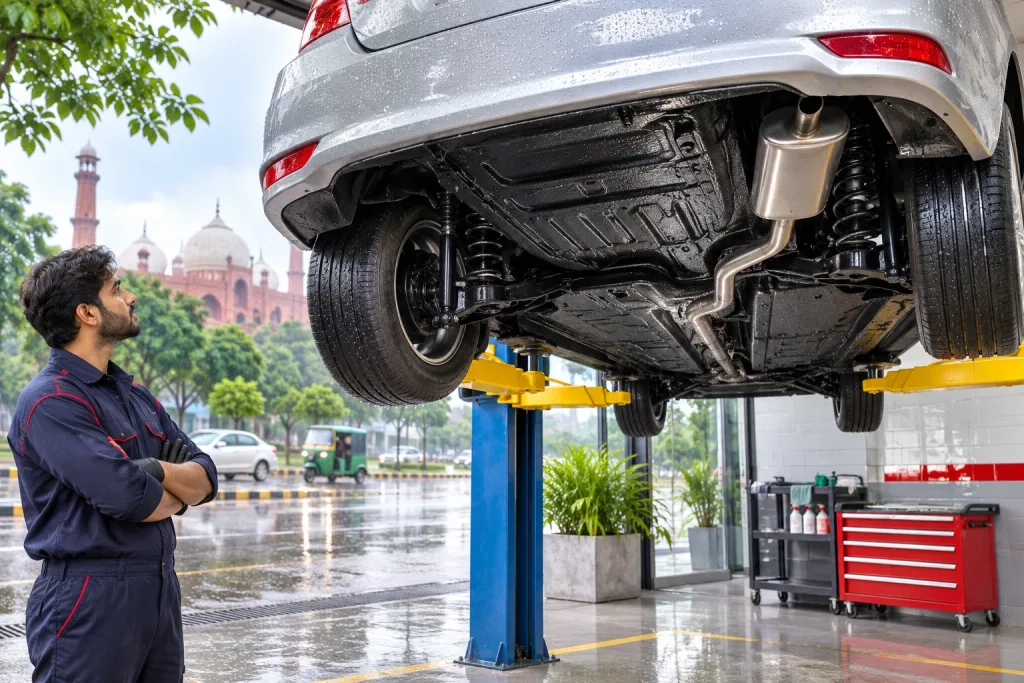
Rust is cheapest to deal with when it is a stain and most expensive when it is a hole. Most owners never look underneath, so the first sign they notice is a bubble in the paint above the sill — by which time the inside of that sill has been rusting for years. Here is what to look for, and where.
Where rust starts
Not on the big flat panels you can see. It starts where water sits and dirt collects: seam flanges and spot welds, the bottom of sills and door skins, jacking points, wheel-arch lips, suspension mounting points, brackets, the edges of the floor pan, around fuel tank straps, and inside enclosed box sections where drains are blocked.
Early signs (surface stage)
- Orange or brown staining running from seams, bolt heads or drain holes after rain.
- Light orange film on bare metal parts underneath — mounts, brackets, rail edges.
- Chips to bare steel behind the wheels and along floor edges.
- Mud packed into arch lips and seams that stays damp for days.
- Drain holes blocked with dirt (look under the sills and doors).
At this stage treatment and protection are straightforward. How surface rust is treated →
Intermediate signs (scale stage)
- Flaking rust that comes off in layers around jacking points, sill bottoms and seams.
- Pitting visible after flakes are removed.
- Old undercoat lifting with rust at the edges.
- Bubbling paint on the outside of sills or arch lips — rust pushing through from behind.
Scale means lost metal thickness. It can sometimes be removed and treated, but the remaining steel must be probed.
Late signs (structural stage)
- Holes or soft spots in sills, floor pan edges or rails.
- Damp carpets or a musty smell inside the car after rain.
- Cracking noises or movement around suspension mounts.
- Jack sinking into the sill when the car is lifted.
This is a body-shop job: cut out and weld, then protect. Coating is not an option here, and anyone offering it should be avoided.
A five-minute owner check
- After a wash, look along the bottom edge of each sill and door for bubbles or stains.
- Kneel and look into the wheel arches with a torch for packed mud and bare chips.
- Check that sill drain holes are open (a thin stream after washing is a good sign).
- Look under the front and rear for orange staining on brackets and mounts.
- Smell the carpets after heavy rain.
Anything beyond stains and chips deserves a proper lift inspection. What the inspection covers →
Lahore factors
Monsoon flooding forces water into sills and seams; humidity keeps enclosed sections damp; mud holds moisture against metal. Cars parked outside and driven through standing water should be checked every year. Local conditions explained →
Related: Can you undercoat over rust? · our undercoating service
Related questions
Can a used car with some rust be undercoated?
Often yes, but only after an honest inspection. Light surface rust can be cleaned, treated and primed before coating. Flaking, scaling or perforated metal cannot simply be sealed over — coating would trap moisture and hide the problem. In those cases we point out what needs welding or replacement first.
What happens during the underbody inspection?
The car is lifted and we check the chassis rails, floor pan, sills, wheel arches, subframes, suspension mounts and seams for rust, damage, leaks, loose heat shields and previous repairs. You get a clear explanation of what we found, what we recommend (including “nothing needed yet” when that is the honest answer) and a written quote. More about inspections.
Does undercoating stop rust completely?
No treatment makes a car rust-proof forever. A well-applied coating on clean metal greatly reduces the moisture and grit contact that drives corrosion, but stone chips, seam movement and neglected damage can still let rust start. That is why we recommend periodic underbody checks rather than a one-time “fit and forget” approach.
Seen a stain or a bubble?
Book an inspection before it becomes a repair. You will get photos and an honest category for each area.