
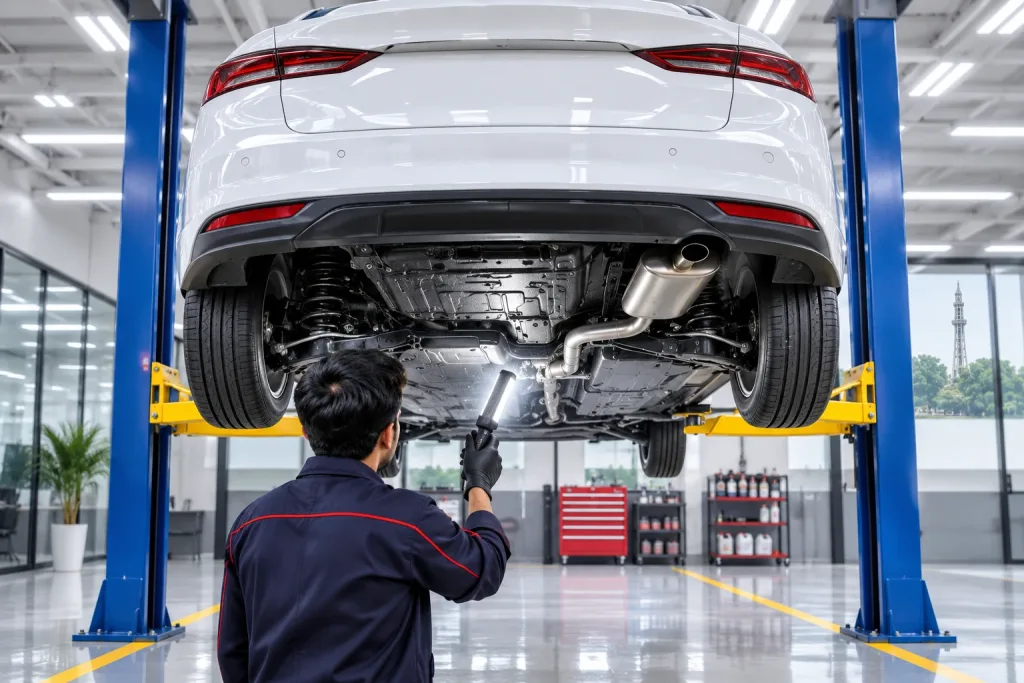
Most of the horror stories about undercoating — smoke from the exhaust, failed sensors, a car that rusts from the inside — come from coating things that should have been masked. This list is what a careful workshop keeps clear, and why.
Exhaust system and heat shields
Coating on a hot exhaust burns, smokes and smells for weeks and can ignite. Heat shields are there to protect the floor from exhaust heat; coating them insulates the wrong way and bakes the coating. Everything from the manifold to the tailpipe, plus shields and hangers, stays clear.
Brake components
Discs, drums, pads, calipers, flexible hoses and hard lines. Coating on friction surfaces affects braking; coating on hoses hides cracking and can degrade the rubber; coating on lines hides corrosion that must be visible at service. All masked.
Sensors and wiring
ABS and wheel-speed sensors, oxygen sensors on the exhaust, parking sensors, ride-height sensors, and the connectors and looms that feed them. Coating insulates, hides damage and makes future repair miserable.
Drive shafts, CV boots, propshaft and steering
Rotating parts fling coating off and the solvents stiffen rubber boots so they split early — which lets grease out and water in. Steering racks, tie-rod ends and ball joints must stay clean so wear can be seen.
Rubber bushings and suspension joints
Solvents in many coatings attack rubber. Bushings swell or harden, mounts crack, and the car develops noises and handling faults months later. Bump stops and anti-roll bar bushes included.
Drain holes and breathers
Sills, doors, chassis rails and some subframes have drain holes so water can escape. Sealing them traps water inside and causes rust from the inside out — the very failure undercoating is meant to prevent. Gearbox and axle breathers must also stay open.
Labels, VIN plates and manufacturer exclusions
Chassis numbers, tyre and emissions labels and some service points must remain readable. Manufacturers also list components they do not want coated; the warranty booklet is the reference.
Moving suspension and steering components generally
Springs, dampers, arms and links can be protected by their own finishes; coating them hides wear and corrosion that technicians need to see. Judgement varies by product and vehicle; when the manufacturer permits a particular component to be coated, we follow that, not habit.
Quick reference
| Component | What goes wrong if coated |
|---|---|
| Exhaust & heat shields | Burning, smoke, odour, fire risk |
| Brake discs, calipers, hoses, lines | Reduced braking; hidden hose cracks and line corrosion |
| ABS / oxygen / parking sensors | Sensor faults, warning lights, hard repairs |
| Drive shafts, CV boots, propshaft | Split boots, thrown coating, hidden wear |
| Rubber bushings & mounts | Swelling, hardening, noises, handling faults |
| Drain holes & breathers | Trapped water → rust from the inside |
| Labels & VIN plates | Illegible identification, inspection problems |
How masking is done properly
Each item above is covered with tape, film or purpose-made covers before spraying, and the masking is removed at the quality check with any overspray cleaned off. It takes time, and it is time well spent. Masking in the six-step process →
Related: materials and safety · What is undercoating? · our undercoating service
Related questions
Which parts should never be coated?
Exhaust pipes and heat shields (coating burns and smokes), brake discs, calipers and lines, ABS and oxygen sensors, drive shafts and CV boots, suspension joints and rubber bushings, drain holes and breather tubes, and any label or part the vehicle manufacturer says must stay uncoated. We mask these before spraying.
Is undercoating safe for my car’s parts and warranty?
Applied correctly — on clean metal, away from exhaust, brakes, sensors, moving parts and drain holes — underbody coating does not harm the car. Problems come from careless application. For warranty, read your manufacturer’s booklet: most permit protective coatings but exclude damage caused by blocked drains or coated components. We work within those limits.
What does the undercoating process involve?
Six stages: inspection on the lift, cleaning and drying, rust treatment where needed, masking of exhaust, brakes, sensors and moving parts, application in even passes at the specified thickness, and a quality check with a lamp before hand-over. Skipping any one of these is where most cheap undercoating jobs go wrong. See the process in detail.
Ready to protect your car’s underside?
Book an underbody inspection. We look first, explain what we find, and only then quote — no pressure, no guesswork.