
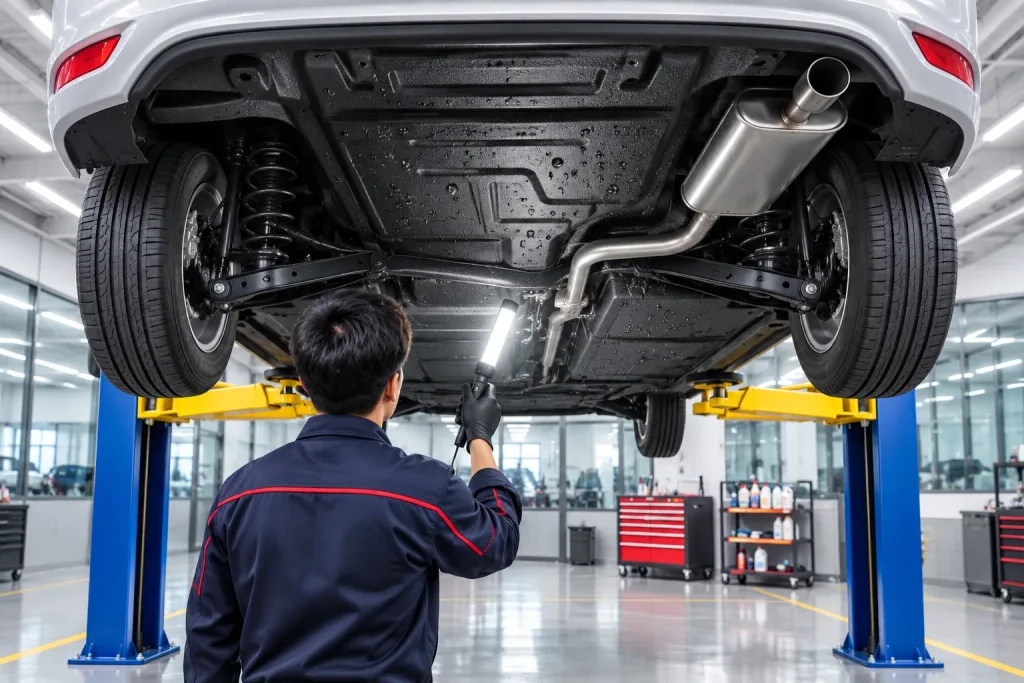
Providers who re-coat on a fixed schedule are selling repeat visits. The coating itself tells you when it needs attention — and most of the time the answer is a small touch-up, not a full re-application. Here is what to look for and when.
When to look
- Once a year on a lift — ideally after the monsoon, when water and mud have done their worst.
- After deep-water driving or a trip on gravel roads.
- After suspension, exhaust, gearbox or clutch work, which disturbs coating around the parts worked on.
- Before selling, so you can document the condition.
Signs that call for a touch-up
- Chips behind the wheels showing bare or lightly rusted metal.
- Small areas scraped off by speed bumps or debris.
- Wax thinning on sill undersides after washing.
- Bare patches where a mechanic removed coating.
A touch-up means cleaning, drying and treating the small area, then re-coating just that spot with a compatible product. Done at an annual check, it keeps the rest of the coating working for years.
Signs that call for a wider re-coat
- Cracking across a large area — typical of aged bitumen.
- Lifting edges that peel back to reveal rust or dampness underneath.
- Widespread thinning on high-wear areas.
- A previous coating that has failed because it was applied over dirt or rust.
Here the failed material must be removed, the metal re-prepared and treated, and the area re-coated. Spraying new over old failing coating only adds another layer that will peel. Why sealing problems in makes them worse →
Product differences
Film coatings (rubberised, polyurethane) on well-prepared metal typically need only touch-ups for years. Bitumen needs watching for cracks. Waxes and oils need planned top-ups as part of how they work — that is not failure, it is design. The product datasheet is the reference. Materials compared →
Do not reapply over a problem
If a check reveals rust under lifting coating, the fix is treatment or repair, not another coat. If drains are blocked, clearing them comes first. Reapplication is the last step of a check, never the first.
Related: How long does undercoating last? · Book an annual check · our undercoating service
Related questions
When should undercoating be reapplied?
When an inspection shows thinning, chipping, cracking or lifting — not on a fixed calendar. Oil-based treatments typically need more frequent top-ups than film coatings. Annual checks catch problems while a small touch-up is enough.
What if a stone chips the coating?
Small chips are normal on any coated underside. If the metal is exposed, have the spot cleaned and touched up before moisture gets under the film. Rubberised and wax-type products are more forgiving of chips than brittle bitumen layers.
How long does underbody coating last?
There is no honest single number. Lifespan depends on the product type, film thickness, how well the metal was prepared, how the car is driven (gravel, floods, speed bumps) and whether chips are touched up. Flexible rubberised and polyurethane coatings generally outlast thin bitumen or oil treatments, but every product’s datasheet gives its own expectations. We recommend an underbody check at least once a year. Read more.
Time for the annual look?
Book an underbody check. Most of the time a small touch-up is all that is needed — and we will tell you if nothing is.